August 01, 2021


May 16, 2021
Pentagon confirms leaked photos and video of UFOs are legitimate
US defense department says images of blinking triangular object in the sky and other UFOs were taken by navy personnel in 2019.
Furthering the growing interest in unidentified flying objects, or what the US government refers to as unidentified aerial phenomena (UAP), the Department of Defense confirmed on Thursday that recently leaked photos and videos of UFOs were legitimate and taken by navy personnel.
Sue Gough, a spokesperson for the Pentagon, confirmed to CNN that images and footage of a blinking triangular object in the sky, along with other UAPs that were categorized as a “sphere”, “acorn” and “metallic blimp”, were taken by navy personnel in 2019.
Gough told CNN that the defense department would not comment further on the nature of the footage or share any examinations into them.
“To maintain operations security and to avoid disclosing information that may be useful to potential adversaries, DoD does not discuss publicly the details of either the observations or the examinations of reported incursions into our training ranges or designated airspace, including those incursions initially designated as UAP,” Gough said in the statement.
Last April, the Pentagon released three videos of UAPs taken in 2004 and 2015 that included audio of pilots amazed at the speed of the objects they were seeing. “Look at that thing, dude!” one pilot said. “It’s rotating!”
May 07, 2021
How Quantum Entanglement works
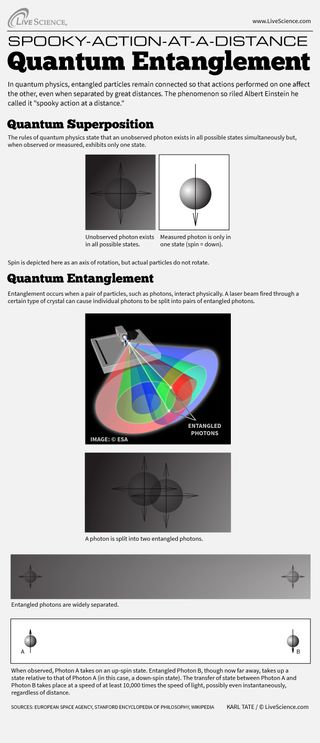
In quantum physics, entangled particles remain connected so that actions performed on one affect the other, even when separated by great distances. The phenomenon so riled Albert Einstein he called it "spooky action at a distance." The rules of quantum physics state that an unobserved photon exists in all possible states simultaneously but, when observed or measured, exhibits only one state. Spin is depicted here as an axis of rotation, but actual particles do not rotate. Entanglement occurs when a pair of particles, such as photons, interact physically. A laser beam fired through a certain type of crystal can cause individual photons to be split into pairs of entangled photons. The photons can be separated by a large distance, hundreds of miles or even more. When observed, Photon A takes on an up-spin state. Entangled Photon B, though now far away, takes up a state relative to that of Photon A (in this case, a down-spin state). The transfer of state between Photon A and Photon B takes place at a speed of at least 10,000 times the speed of light, possibly even instantaneously, regardless of distance. A proposed experiment would send one photon of the entangled pair to the orbiting International Space Station, a distance of around 310 miles (500 kilometers). This would be the largest distance that has been experimentally tested.
April 22, 2021
What If the Big Bang Wasn't the Beginning? New Study Proposes Alternative
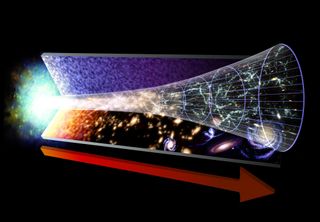 |
The universal origin story known as the Big Bang postulates that, 13.7 billion years ago, our universe emerged from a singularity — a point of infinite density and gravity — and that before this event, space and time did not exist (which means the Big Bang took place at no place and no time). There is ample evidence to show that the universe did undergo an early period of rapid expansion — in a trillionth of a trillionth of a trillionth of a second, the universe is thought to have expanded by a factor of 1078 in volume. For one, the universe is still expanding in every direction. The farther away an object is, the faster it appears to move away from an observer, suggesting that space itself is expanding (rather than objects simply moving through space at a steady rate). [Big Bang Theory: 5 Weird Facts About the Universe's Birth]. |
The Beginning to the End of the Universe: Exploring the shape of space-time
The afterglow of the Big Bang reveals the geometry of the universe.
 | |
| Einstein’s field equations describe gravity not as a force, but rather a
property of space-time — the fabric of the universe. Earth travels
around the Sun in a circular orbit because the Sun’s mass deforms the
space-time around it like a bowling ball on a trampoline. |
In ancient times, scholars such as Aristotle thought that heavy objects would fall faster than lightweight objects under the influence of gravity. About four and a half centuries ago, Galileo Galilei decided to test this assumption experimentally. He dropped objects of different masses from the Tower of Pisa and found that gravity actually causes them all to fall the same way. More than 300 years later, Albert Einstein was struck by Galileo’s finding. He realized that if all objects follow the same trajectory under gravity, then gravity might not be a force but rather a property of space-time — the fabric of the universe, which all objects experience in the same way.
In one of the most important advances in modern physics, Einstein recognized that when space-time is curved, objects do not follow straight lines. He reckoned that Earth, for example, orbits the Sun in a circle because the Sun curves space-time in its vicinity. This is similar to the path of a ball on the surface of a trampoline whose center is weighed down by a person.
In November 1915, Einstein published the mathematical equations that established the foundation for his general theory of relativity. These equations describe the link between matter and the space-time in which it resides, showing that mass deforms space-time and influences the path of matter. In the words of physicist John Wheeler: “Space-time tells matter how to move and matter tells space-time how to curve.”
Can gravity form waves?
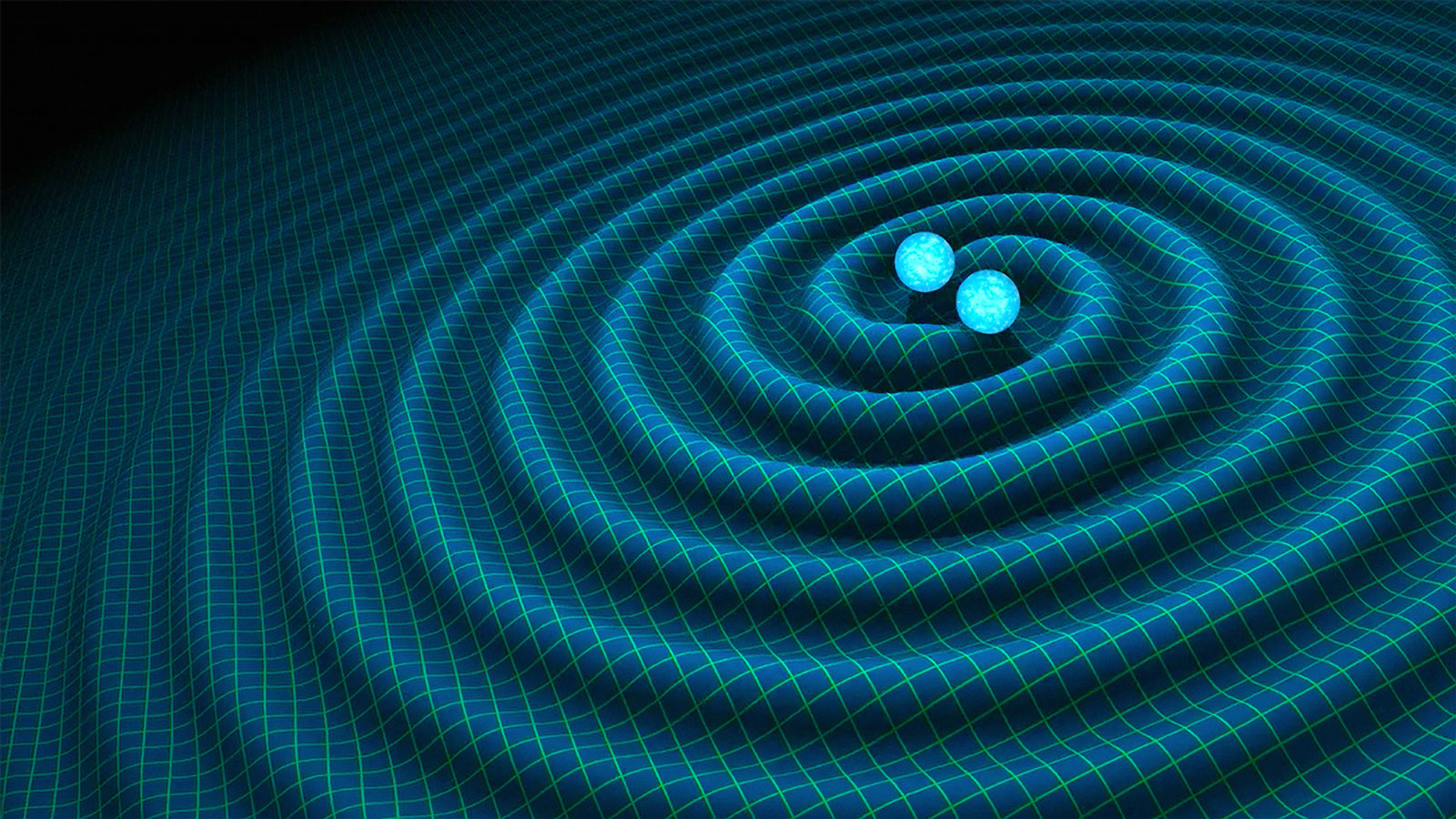 | ||||
| Artistic conception of gravitational waves. Public Domain Image, source: R. Hurt/Caltech-JPL. |
Yes, gravity can forms waves. Gravitational waves are ripples in spacetime that travel through the universe. If you think of gravity as a force acting at a distance, it is difficult to visualize how gravitational waves could form. However, if you use the more accurate description of gravity that was developed by Einstein in his general theory of relativity, these concepts become more logical.
General relativity describes gravity as a warping or curvature of space and time. All objects warp spacetime. When other objects travel through this warped spacetime, they end up traveling along curved paths. These curved paths look like they result from a force being exerted on the objects, when in reality they result from spacetime itself being warped. For instance, when you throw a baseball to your friend, it follows a smooth parabolic trajectory under the influence of gravity. Isaac Newton's laws would say that earth's mass is creating a gravitational force which acts on the baseball, gradually pulling the baseball down from straight-line motion. However, the more accurate description goes like this: The earth warps space and time. The baseball is actually traveling in a straight line relative to spacetime, but since spacetime itself is curved, this straight line becomes a curve when viewed by an external observer. In this way, there is not really any direct force acting on the baseball. It just looks that way because of the spacetime warpage. If all of this sounds too strange to be believed, you should know that Einstein's general relativity has been mainstream science for over a hundred years and has been verified by countless experiments.
In principle, all objects warp spacetime. However, low-mass objects such as houses and trees warp spacetime to such a small extent that it's hard to notice their effects. It takes high-mass objects such as planets, moons, or stars in order for the gravitational effects to be noticeable. The more mass an object has, the more it warps spacetime, and the stronger its gravitational effect on other objects. For instance, a black hole has such a high amount of mass in such a small volume that even light cannot escape. Inside the event horizon of a black hole, spacetime is so strongly warped that all possible paths that light can take eventually lead deeper into the black hole.
Since spacetime warpage is caused by mass, the warpage travels along with the mass. For instance, earth warps the surrounding spacetime into an inward-pinched shape (roughly speaking). As the earth travels around the sun in its year-long orbit, this pattern of spacetime curvature travels along with the earth. An observer that is stationary relative to the sun and is at a point close to earth's path would see the earth get closer and then farther away, closer and then farther away, in one-year cycles. Therefore, this observer would see earth's pinched spacetime pattern come closer and then farther away, closer and then farther away, in one-year cycles. Because the observer himself sits in spacetime and experiences it, the observer therefore sees his own local spacetime as being pinched, and then not pinched, pinched and then not pinched, in one-year cycles. The observer is therefore experiencing an oscillation of spacetime curvature that is traveling outward from the earth, i.e. a gravitational wave. This actually happens in the real world. However, in practice, gravitational waves are so incredibly weak that they have no significant effect on daily life. The oscillating spacetime warpage of a passing gravitational wave is far too weak for humans to notice or feel. Only very sensitive, expensive, modern equipment is able to detect gravitational waves. In fact, it took a hundred years after Einstein predicted the existence of gravitational waves for technology to improve enough to be able to detect them.
This idea of periodically-pinched spacetime is over-simplified. If you apply the full mathematics of general relativity, you find that an observer experiencing a passing gravitational wave does not experience a cycling pattern of spacetime pinching and no pinching. Rather, the observer experiences a cycling pattern of stretching in the sideways directions with pinching in the other sideways directions, and then pinching in the first sideways directions with stretching in the other sideways directions. For instance, suppose a gravitational wave from a distant star traveled straight down toward earth's surface right where you sit. If the gravitational wave were a thousand trillion times stronger than it can actually get in the real world, then you would see a ruler that is aligned with the east-west directions momentarily become shorter while a ruler that is aligned with the north-south directions momentarily become longer. And then a moment later, the east-west ruler would become longer while the north-south ruler would be shorter. Each ruler would continue to get periodically longer and shorter until the gravitational wave has passed. There is nothing wrong with the rulers. Spacetime itself is warping and everything in spacetime experiences the warping.
Although this effect is very weak, it actually happens. A gravitational wave detector is effectively just a very long ruler with the ability to measure the length of the ruler very accurately. For instance, each arm of a LIGO detector is 2.5 miles long and uses lasers to accurately measure lengths. Even with large, modern, expensive detectors, gravitational waves are so weak that only the largest waves can currently be detected. The current detectors cannot pick up the gravitational waves generated by planets orbiting stars or moons orbiting planets. The largest gravitational waves are generated when two black holes orbit each other rapidly immediately before falling together and merging. Large waves are also generated when two neutron stars orbit each other, or when a black hole and a neutron star orbit each other, immediately before merging. These are the only types of gravitational waves that have been detected so far.
In general, a gravitational wave is created any time a mass accelerates. Traveling along a circular path is only one type of acceleration. If an object with mass speeds up along a straight path, this is also a type of acceleration, and therefore it should create gravitational waves. Similarly, an object with mass slowing down along a straight path should also create gravitational waves. However, on the astronomical scale, an object traveling steadily along a circular orbit is far more common than an object violently slowing down or speeding up.
Another point to keep in mind is that the gravitational waves created by the earth in its yearly orbit are not only extremely weak, they also have a period of one year. This means that a gravitational wave detector on another planet would have to watch for several years in order to pick up the oscillatory shape of the gravitational waves generated by earth's orbital motion. In contrast, immediately before two black holes merge, they orbit each other so rapidly that it only takes a fraction of a second for each to complete an orbit. This is another factor that makes these types of gravitational waves easier to detect.
Credit:wtamu.edu
April 15, 2021
Subscribe to:
Posts (Atom)