February 07, 2021

Student astronomer finds missing galactic matter

Student astronomer finds galactic missing matter 

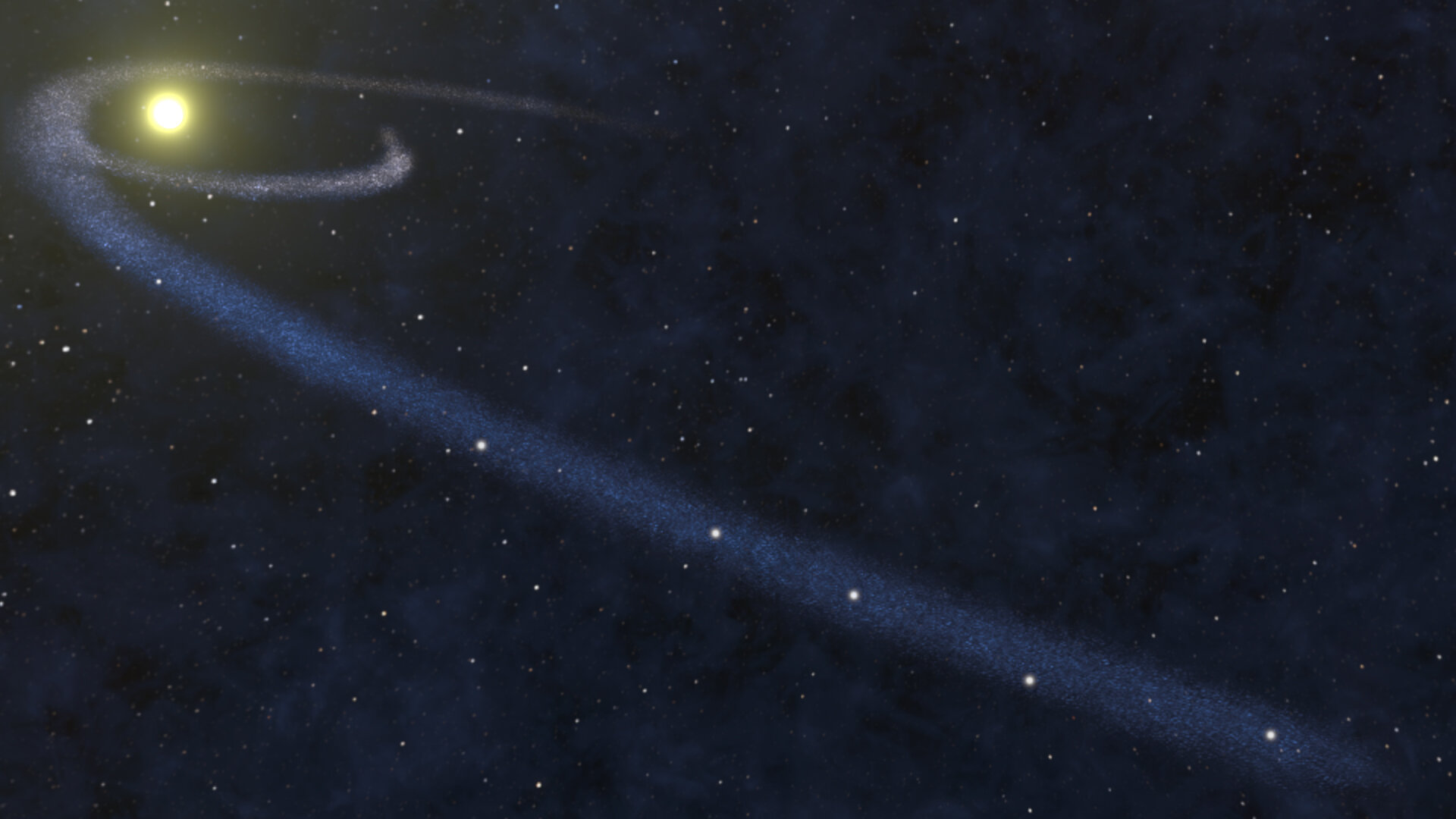
Artist's impression of a gas cloud from tidal disruption. Credit: University of Sydney


Astronomers have for the first time used distant galaxies as 'scintillating pins' to locate and identify a piece of the Milky Way's missing matter.  

For decades, scientists have been puzzled as to why they couldn't account for all the matter in the universe as predicted by theory. While most of the universe's mass is thought to be mysterious dark matter and dark energy, 5 percent is 'normal matter' that makes up stars, planets, asteroids, peanut butter and butterflies. This is known as .

However, direct measurement has only accounted for about half the expected baryonic matter.

Yuanming Wang, a in the School of Physics at the University of Sydney, has developed an ingenious method to help track down the missing matter. She has applied her technique to pinpoint a hitherto undetected stream of cold gas in the Milky Way about 10 from Earth. The cloud is about a trillion kilometers long and 10 billion kilometers wide but only weighing about the mass of our Moon.

The results, published in the Monthly Notices of the Royal Astronomical Society, offer a promising way for scientists to track down the Milky Way's missing matter.

"We suspect that much of the 'missing' baryonic matter is in the form of cold gas clouds either in galaxies or between galaxies," said Ms Wang, who is pursuing her Ph.D. at the Sydney Institute for Astronomy.

"This gas is undetectable using conventional methods, as it emits no of its own and is just too cold for detection via ," she said.

What the astronomers did is look for radio sources in the distant background to see how they 'shimmered'.

"We found five twinkling radio sources on a giant line in the sky. Our analysis shows their light must have passed through the same cold clump of gas," Ms Wang said.

Just as visible light is distorted as it passes through our atmosphere to give stars their twinkle, when radio waves pass through matter, it also affects their brightness. It was this 'scintillation' that Ms Wang and her colleagues detected.

Dr. Artem Tuntsov, a co-author from Manly Astrophysics, said: "We aren't quite sure what the strange cloud is, but one possibility is that it could be a hydrogen 'snow cloud' disrupted by a nearby star to form a long, thin clump of gas."

Hydrogen freezes at about minus 260 degrees and theorists have proposed that some of the universe's missing baryonic matter could be locked up in these hydrogen 'snow clouds'. They are almost impossible to detect directly.

"However, we have now developed a method to identify such clumps of 'invisible' cold gas using background galaxies as pins," Ms Wang said.

Ms Wang's supervisor, Professor Tara Murphy, said: "This is a brilliant result for a young astronomer. We hope the methods trailblazed by Yuanming will allow us to detect more missing matter."

The data to find the gas cloud was taken using the CSIRO's Australian Square Kilometre Array Pathfinder (ASKAP) radio telescope in Western Australia.

Dr. Keith Bannister, Principal Research Engineer at CSIRO, said: "It is ASKAP's wide field of view, seeing tens of thousands of galaxies in a single observation that allowed us to measure the shape of the gas cloud."

Professor Murphy said: "This is the first time that multiple 'scintillators' have been detected behind the same cloud of cold gas. In the next few years, we should be able to use similar methods with ASKAP to detect a large number of such gas structures in our galaxy."

Ms Wang's discovery adds to a growing suite of tools for astronomers in their hunt for the universe's missing baryonic matter. This includes a method published last year by the late Jean-Pierre Macquart from Curtin University who used CSIRO's ASKAP telescope to estimate a portion of matter in the intergalactic medium using fast radio bursts as 'cosmic weigh stations'. 


Source:phys.org


Twin Paradox


February 06, 2021

Neutrino

Risultato immagini per neutrino 

A neutrino is a subatomic particle that is very similar to an electron, but has no electrical charge and a very small mass, which might even be zero. Neutrinos are one of the most abundant particles in the universe. Because they have very little interaction with matter, however, they are incredibly difficult to detect. Nuclear forces treat electrons and neutrinos identically; neither participate in the strong nuclear force, but both participate equally in the weak nuclear force. Particles with this property are termed leptons. 

In addition to the electron (and it's anti-particle, the positron), the charged leptons include the muon (with a mass 200 times greater than that of the electron), the tau (with mass 3,500 times greater than that of the electron) and their anti-particles. Both the muon and the tau, like the electron, have accompanying neutrinos, which are called the muon-neutrino and tau-neutrino. The three neutrino types appear to be distinct: For instance, when muon-neutrinos interact with a target, they will always produce muons, and never taus or electrons. In particle interactions, although electrons and electron-neutrinos can be created and destroyed, the sum of the number of electrons and electron-neutrinos is conserved.  

This fact leads to dividing the leptons into three families, each with a charged lepton and its accompanying neutrino.

To detect neutrinos, very large and very sensitive detectors are required. Typically, a low-energy neutrino will travel through many light-years of normal matter before interacting with anything. Consequently, all terrestrial neutrino experiments rely on measuring the tiny fraction of neutrinos that interact in reasonably sized detectors. For example, in the Sudbury Neutrino Observatory, a 1000 ton heavy water solar-neutrino detector picks up about 1012 neutrinos each second. About 30 neutrinos per day are detected. 

Wolfgang Pauli first postulated the existance of the neutrino in 1930. At that time, a problem arose because it seemed that both energy and angular momentum were not conserved in beta-decay. But Pauli pointed out that if a non-interacting, neutral particle--a neutrino--were emitted, one could recover the conservation laws. The first detection of neutrinos did not occur until 1955, when Clyde Cowan and Frederick Reines recorded anti-neutrinos emitted by a nuclear reactor.

Natural sources of neutrinos include the radioactive decay of primordial elements within the earth, which generate a large flux of low-energy electron-anti-neutrinos. Calculations show that about 2 percent of the sun's energy is carried away by neutrinos produced in fusion reactions there. Supernovae too are predominantly a neutrino phenomenon, because neutrinos are the only particles that can penetrate the very dense material produced in a collapsing star; only a small fraction of the available energy is converted to light. It is possible that a large fraction of the dark matter of the universe consists of primordial, Big Bang neutrinos.

The fields related to neutrino particles and astrophysics are rich, diverse and developing rapidly. So it is impossible to try to summarize all of the activities in the field in a short note. That said, current questions attracting a large amount of experimental and theoretical effort include the following: What are the masses of the various neutrinos? How do they affect Big Bang cosmology? Do neutrinos oscillate? Or can neutrinos of one type change into another type as they travel through matter and space? Are neutrinos fundamentally distinct from their anti-particles? How do stars collapse and form supernovae? What is the role of the neutrino in cosmology?

One long-standing issue of particular interest is the so-called solar neutrino problem. This name refers to the fact that several terrestrial experiments, spanning the past three decades, have consistently observed fewer solar neutrinos than would be necessary to produce the energy emitted from the sun. One possible solution is that neutrinos oscillate--that is, the electron neutrinos created in the sun change into muon- or tau-neutrinos as they travel to the earth. Because it is much more difficult to measure low-energy muon- or tau-neutrinos, this sort of conversion would explain why we have not observed the correct number of neutrinos on Earth.


Source : Scientific Americn


It is possible to enter in a black hole in "safety", but under two conditions

Risultato immagini per interstellar black hole man in a black hole

There is a chance to enter in a black hole. This possibility is told in a new book issued by a couple of physicists. First of all, let go of all hope or you who enter because, simply said, once you have passed a certain threshold you will not be able to leave.

There are different types of black holes: those with a mass similar to that of our Sun and those with a mass billions of times our star. The key to entering a black hole unscathed is the event horizon, the boundary beyond which not even light can go back. A cosmic monster with a mass similar to our Sun, for example, will have an event horizon with a radius of just under 3.2 kilometers; while a supermassive black hole will have an event horizon of millions of kilometers.  

Therefore, someone who falls into a stellar-sized black hole will get much, much closer to the center of the black hole before passing the event horizon. Due to the proximity of the center, therefore, the gravitational pull on the person will differ by a factor of 1,000 billion times between the head and toes. The subject would then be "spaghettified" instantly, facing certain death. A person falling into a supermassive black hole, on the other hand, would be much further away from the central source of gravitational attraction, which means that the difference in gravitational attraction between the head and toes is almost zero: it is therefore possible. overcome the event horizon unscathed. There is another indispensable condition for entering this cosmic monster: the supermassive black hole must be isolated; that is, it must not have a rotating accretion disk around it. Once these two important steps have been overcome, know that the discoveries made inside this mysterious place can never be communicated and you will never be able to go back ... we are therefore destined for something that is unknown.


Source:science alert  

February 04, 2021

The Universe Is not Flat

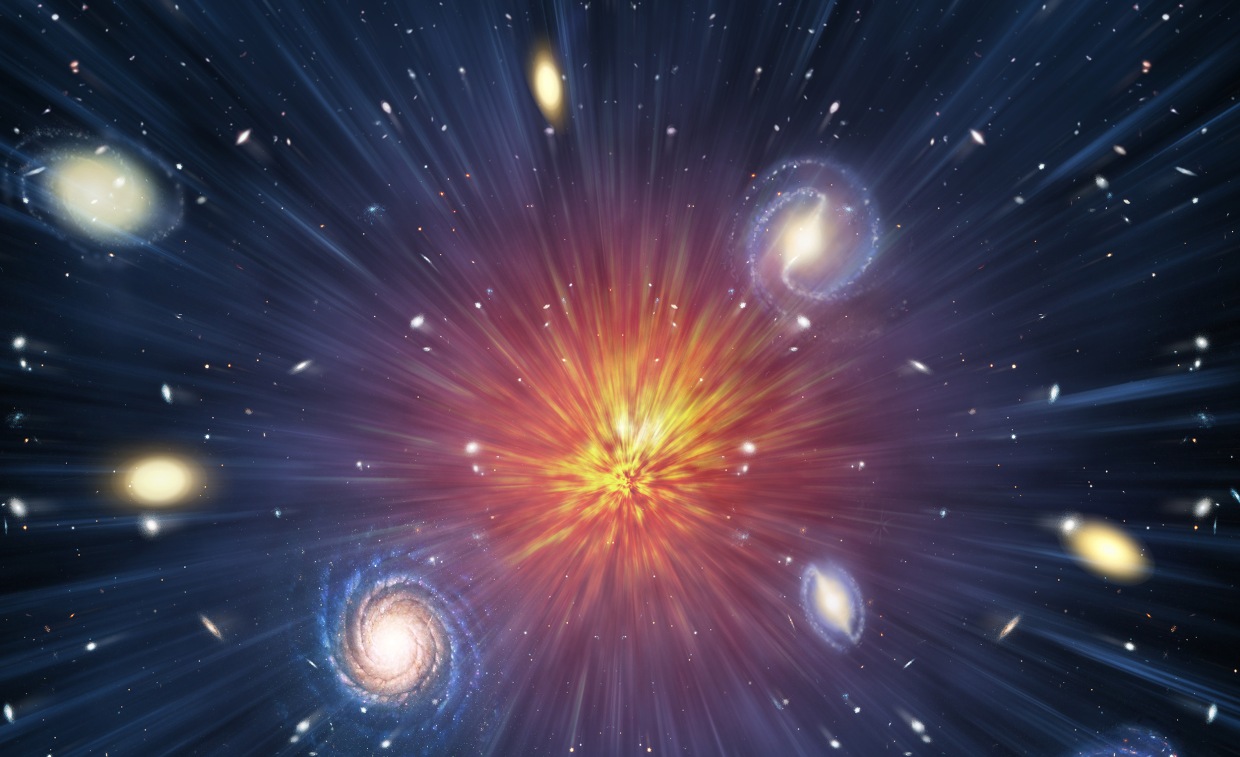
Una rappresentazione schematica dell'evoluzione dell'Universo 

 A schematic representation of the evolution of the Universe, from the Big Bang to today, 13.8 billion years later. N.R. Fuller, National Science Foundation

The recent Planck Legacy 2018 release has confirmed the presence of an enhanced lensing amplitude in cosmic microwave background power spectra compared with that predicted in the standard Λ cold dark matter model, where Λ is the cosmological constant. A closed Universe can provide a physical explanation for this effect, with the Planck cosmic microwave background spectra now preferring a positive curvature at more than the 99% confidence level. Here, we further investigate the evidence for a closed Universe from Planck, showing that positive curvature naturally explains the anomalous lensing amplitude, and demonstrating that it also removes a well-known tension in the Planck dataset concerning the values of cosmological parameters derived at different angular scales.


Source:Nature Astronomy


February 03, 2021

Vacuum energy and Dark energy

Vacuum energy is a quantity of energy present everywhere in space even when devoid of matter, which makes empty space not completely empty. This energy is linked to quantum fluctuations, which determine the continuous fleeting appearance and annihilation of particles and antiparticles.

Dark energy is an unidentified component of the Universe that is thought to be present in such a large quantity that it overcomes all other components of matter and energy put together. According to the most recent estimates from ESA's Planck mission, dark energy contributes 68 percent of the matter-energy density of the Universe.

One way to envisage the dark energy is that it seems to be linked to the vacuum of space. In other words it is an intrinsic property of the vacuum. So, the larger the volume of space, the more vacuum energy (dark energy) is present and the greater its effects.

The evidence for dark energy came to light in the late-1990s from observations of supernovae. These exploding stars are extremely bright and can be seen across large swathes of the cosmos. By searching for a specific type of supernova, known as supernova Ia, which all explode with about the same amount of energy, astronomers can use them to gauge cosmological distances and thus calculate how fast the Universe has been expanding in the past compared to now.

This work was expected to show that the expansion was slowing down because it was being resisted by the gravity of all the Universe's celestial objects. In 1988, American astronomer Saul Perlmutter launched a group to make these measurements, called The Supernova Cosmology Project. They were joined in 1994 by an independent group called The High-z Supernova Search Team, led by American Australian astronomer Brian Schmidt and in which American astronomer Adam Riess played a crucial role.

By 1998, the two teams had their results and instead of the expected deceleration, both had found that the expansion was accelerating. This was completely unexpected because nothing in known physics was capable of producing this effect. In keeping with the naming of the mysterious dark matter, astronomers began referring to whatever was causing the acceleration as dark energy.

Expansion history of the Universe. Credit: Euclid Assessment Study Report

Now almost a quarter of a century after its discovery, understanding the acceleration remains one of the most compelling challenges of cosmology and fundamental physics. The precise nature of dark energy continues to remain mysterious. The best working hypothesis is something that Albert Einstein suggested back in 1917. Shortly after he published the General Theory of Relativity, his description of the gravity and the Universe on its largest scales, Einstein introduced the 'cosmological constant' into his calculations.

The cosmological constant is an energy field that is present across the entire Universe, in technical terms it is called a scalar field. Einstein initially introduced it to resist the pull of gravity from all the celestial objects and hold the Universe stable and unmoving. However, the discovery that the Universe was expanding rendered Einstein's use of the cosmological constant redundant. He struck it from his equations and is even reported to have called it his biggest 'blunder'.

Now cosmologists have re-introduced the cosmological constant because it could be the simplest way to explain the observations. There are alternative suggestions. For example, the acceleration could be produced by a new force of nature or due to a misunderstanding of the way General Relativity works. Each explanation subtly alters the way the acceleration develops across cosmic time but as yet no experiment has been capable of measuring the acceleration in sufficient detail to distinguish between the possible solutions.

Euclid is different. It has been designed to reach unprecedented levels of observational accuracy. This will allow it to precisely map the distribution of galaxies over the last 10 billion years of cosmic history. In so doing, it will finally reveal the precise way dark energy has accelerated the Universe, and allow astronomers to distinguish between a cosmological constant and many of the alternatives. For example, the Euclid mission is required to measure the variation of the cosmic acceleration – the so-called "jerk" – to an accuracy of better than 10 percent. This will show whether the cosmological constant is indeed constant. If it is not, then the lambda-CDM model cannot work and will need replacing.

Beyond even this, the evolution of cosmic structures can directly test general relativity itself. Euclid will measure "gamma", the index of structure growth, to within an accuracy of 2 percent. If this test fails then general relativity does not hold on cosmological scales, and will need replacing with a deeper theory. So again, Lambda-CDM can't be true and cosmologists will have to look for new physics to match the Euclid results.


Source:Esa


February 02, 2021

Here is the identity card of the Universe. What we see is only 4% of what it contains. Everything else is 'dark'

Confirming previous experiments, the WMAP satellite has shown that the visible matter that surrounds us (including mountains, planets, stars and galaxies) is only an insignificant four percent of the universe's total mass and energy content. (Most of this four percent is in the form of hydrogen and helium, and only 0.03 is likely to be made up of the heavier elements.) In reality, most of the universe is made up of some mysterious, invisible material the nature of which is totally unknown. 

The familiar elements that make up our world make up only 0.03 percent of the universe. In a sense, science has been pushed back centuries, before the birth of the atomic hypothesis, with physicists grappling with the fact that the universe is dominated by entirely new and unknown forms of matter and energy. 

According to WMAP, 23 percent of the universe is made up of a strange and indeterminate substance called dark matter: it has weight, it surrounds galaxies with gigantic halos, but it is totally invisible. Dark matter is so widespread and abundant that in our galaxy, the Milky Way, its mass is ten times that of all stars. Although invisible, this strange dark matter can be observed indirectly by scientists since it deflects light, just like a glass lens, and can therefore be identified thanks to the magnitude of the optical distortion it introduces.

Perhaps, however, the biggest surprise caused by the WMAP data, data that has stirred the scientific community, is that 73 percent of the universe is composed of a form of energy completely unknown known as dark energy, which is the invisible energy hidden in the vacuum of space.  

Introduced by Einstein himself in 1917 and later put aside by himself (he called it "my biggest blunder"), dark energy, or energy of nothingness, or empty space, is now re-emerging as the driving force of everything the universe. It is currently believed that it generates a new anti-gravity field that is at the origin of the distancing of galaxies. The final fate of the universe itself will be determined by dark energy.  


Cosmic 'hotspots' may be relics of a universe that existed before ours


The secret of dark matter is the existence of a fifth dimension

 What Is Dark Matter?

The Standard Model contains all the knowledge of Physics accepted and widely verified by the scientific community. However, there are many phenomena that need new theories to be explained, not yet fully confirmed. Some examples of still "unofficial" theories are the theory of neutrino oscillations and string theory, which tries to incorporate the grammar of quantum physics into Einstein's theory of General Relativity.

Another important example is given by the theories on dark matter. Recently, theoretical physicists from the Johannes Gutenberg University of Mainz exposed, in an article published in the European Physical Journal C, a new theory that discusses the hierarchies of the masses of elementary particles and the existence of dark matter. The theory is based on a 1920 idea by Theodor Kaluza and Oskar Klein, according to which there is a fifth dimension in which the gravitational force and the electromagnetic force coincide. This dimension, unlike the three spatial dimensions and the temporal dimension, would not be perceptible to our senses. 

By extending the equations of physics to this fifth dimension, the group predicted the existence of a new particle, a boson with properties similar to the famous Higgs boson (extremely mentioned in Death Stranding), but with such a high mass that it could not not even created inside the largest particle accelerator in the world, the Large Hadron Collider (LHC) at CERN in Geneva. In general, bosons have the role of transmitting ("mediating") forces: this new particle would have the role of mediating a new force, which would act between the visible matter of our universe and the mysterious dark matter. 

The theory seems to be able to explain the incredible abundance of dark matter thought to exist in our universe. The new particle could therefore be measured experimentally during the study of dark matter, without having to wait for an upgrade of modern particle accelerators to reach the very high energies required.  

Source:Phisorg 

January 29, 2021

Quantum Gravity

Quantum gravity (QG) is a field of theoretical physics that seeks to describe gravity according to the principles of quantum mechanics, and where quantum effects cannot be ignored, such as in the vicinity of black holes or similar compact astrophysical objects where the effects of gravity are strong, such as neutron stars.

Three of the four fundamental forces of physics are described within the framework of quantum mechanics and quantum field theory. The current understanding of the fourth force, gravity, is based on Albert Einstein's general theory of relativity, which is formulated within the entirely different framework of classical physics. However, that description is incomplete: describing the gravitational field of a black hole in the general theory of relativity, physical quantities such as the spacetime curvature diverge at the center of the black hole. 

Read more 

Possible Mass of Dark Matter

We may not know what dark matter is, but scientists now have a better idea of what to look for.

Based on quantum gravity, physicists have worked out new, much more stringent upper and lower mass limits of dark matter particles. And they have found that the mass range is way tighter than previously thought.

This means that the dark matter candidates that are either extremely light or heavy are unlikely to be the answer, based on our current understanding of the Universe.

"This is the first time that anyone has thought to use what we know about quantum gravity as a way to calculate the mass range for dark matter. We were surprised when we realised no-one had done it before - as were the fellow scientists reviewing our paper," said physicist and astronomer Xavier Calmet of the University of Sussex in the UK.

"What we've done shows that dark matter cannot be either 'ultra-light' or 'super-heavy' as some theorise - unless there is an as-yet unknown additional force acting on it. This piece of research helps physicists in two ways: it focuses the search area for dark matter, and it will potentially also help reveal whether or not there is a mysterious unknown additional force in the Universe."

Dark matter is undeniably one of the biggest mysteries of the Universe as we know it. It's the name we give to a mysterious mass responsible for gravitational effects that can't be explained by the stuff we can detect by other means - the normal matter such as stars, dust, and galaxies.


For example, galaxies rotate much faster than they should if they were just being gravitationally influenced by the normal matter in them; gravitational lensing - the bending of spacetime around massive objects - is far stronger than it should be. Whatever is creating this additional gravity is beyond our ability to detect directly.

We know it only by the gravitational effect it has on other objects. Based on this effect, we know there is a lot of it out there. Roughly 80 percent of all matter in the Universe is dark matter. It's called dark matter because, well, it's dark. And also mysterious.

However, we do know that dark matter interacts with gravity, so Calmet and his colleague, physicist and astronomer Folkert Kuipers of the University of Sussex, turned to the qualities of quantum gravity to try and estimate the mass range of a hypothetical dark matter particle (whatever it may be).

Quantum gravity, they explain, places a number of bounds on whether dark matter particles of various masses can exist. While we don't have a decent working theory that unites general relativity's space-bending description of gravity with the discrete chunkiness of quantum physics, we know any melding of the two would reflect certain fundamentals of both. As such, dark matter particles would have to obey quantum gravitational rules on how particles break down or interact.

By carefully accounting for all these bounds, they were able to rule out mass ranges unlikely to exist under our current understanding of physics.

Based on the assumption that only gravity can interact with dark matter, they determined that the mass of the particle should fall between 10-3 electronvolts and 107 electronvolts, depending on the spins of the particles, and the nature of dark matter interactions.

That's insanely smaller than the 10-24 electronvolt to 1019 gigaelectronvolt range traditionally ascribed, the researchers said. And that's important, because it largely excludes some candidates, such as WIMPs (weakly interacting massive particles).

If such candidates do later turn out to be the culprit behind the dark matter mystery, according to Calmet and Kuipers, it would mean they are being influenced by some force we don't yet know about.

That would be really cool, because it would point to new physics - a new tool for analysing and understanding our Universe.

Above all, the team's constraints provide a new frame to consider in the search for dark matter, helping narrow down where and how to look.

"As a PhD student, it's great to be able to work on research as exciting and impactful as this," Kuipers said. "Our findings are very good news for experimentalists as it will help them to get closer to discovering the true nature of dark matter."

The research has been published in Physics Letters B.


 Source:Science alert


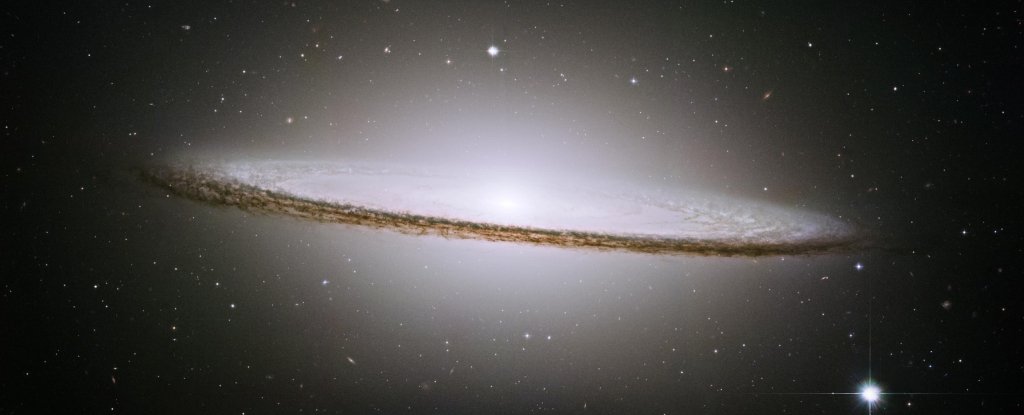
 Sombrero Galaxy, a perfect object for calculating galaxy rotation speed. (NASA/Hubble Heritage Team/STScI/AURA)